There is a growing narrative across the tech industry that because AI models can generate hundreds of lines of code in seconds, software development is suddenly becoming "free."
That assumption makes a fundamental mistake: it confuses the act of typing syntax with the discipline of building valuable software.
Code was expensive. It still is.
The Agricultural Shift
A few centuries ago, the vast majority of the population worked in agriculture just to ensure society had enough food to survive. It was backbreaking, manual, and required immense human labor for relatively modest yields.
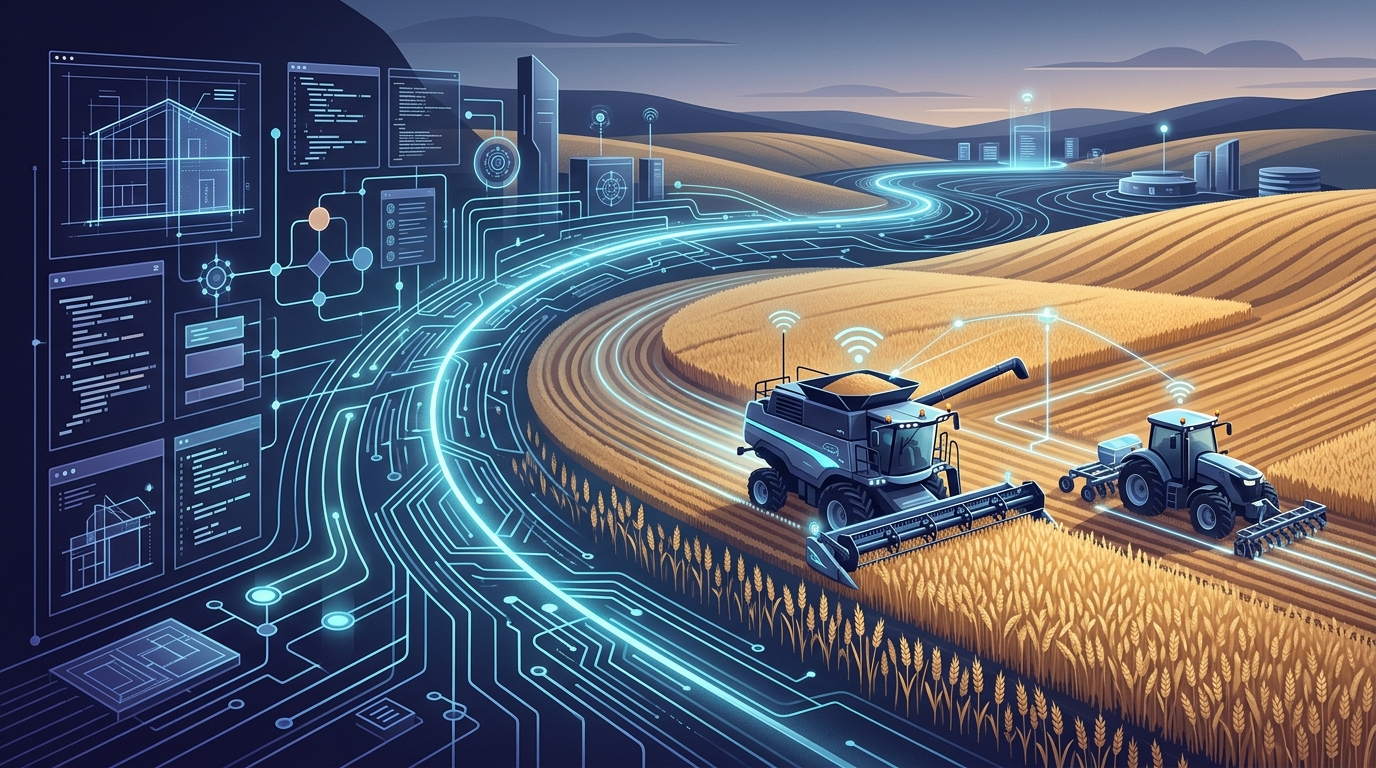
Today, farmers make up only a tiny fraction of the workforce, yet they produce vastly more food than ever before. Mechanization, tractors, combine harvesters, and precision technologies didn't eliminate farming—they transformed the leverage of the farmer. Nobody measures the success of a farm by how many hours were spent swinging a scythe by hand; the value was always in feeding people.
Software development is experiencing its own agricultural revolution. We won't need armies of developers manually churning out routine boilerplate line-by-line. A smaller, highly leveraged group of engineers operating powerful AI tools and high-level abstractions will produce significantly more output than before.
Why Code Is Still Expensive
If generating code is nearly instantaneous, why is software still expensive? Because writing the lines was never where the real cost lived.
Code is a liability, not an asset. The asset is the problem solved or the capability delivered; the liability is every line of code you must test, deploy, secure, debug, and maintain over its lifecycle.
When code becomes cheap to produce, human nature leads us to produce far more of it. But generating more code without disciplined architecture only compounds technical debt, increases cognitive load, and creates bloated systems that are fragile and difficult to reason about. The downstream expense of maintaining, operating, and understanding software hasn't vanished—in many cases, unchecked generation makes it more expensive.
Value Is in Writing the Right Software
Producing bad software faster just accelerates how quickly you create a mess.
The true value in engineering has always resided in what happens before and around the code:
- Understanding the real problem: Uncovering what users and businesses actually need, rather than what they initially asked for.
- Knowing what not to build: Eliminating unnecessary complexity before it ever gets written.
- Designing resilient architectures: Structuring systems so they can evolve gracefully without collapsing under their own weight.
- Evaluating trade-offs: Making tough, informed decisions about performance, security, cost, and maintainability.
Just as a modern agriculturalist needs deep expertise in soil science, crop rotation, and machinery operations rather than just raw physical endurance, modern software engineers must focus on domain judgment, system design, and product clarity.
The Bottom Line
AI tools give us unprecedented leverage, like tractors rolling into fields of manual labor. But the tractor doesn't decide what crops to plant, how to navigate a drought, or which harvest will sustain the community.
Don't confuse the volume of generated code with the value delivered. The value was never in the keystrokes—it was, and always will be, in writing the right software.